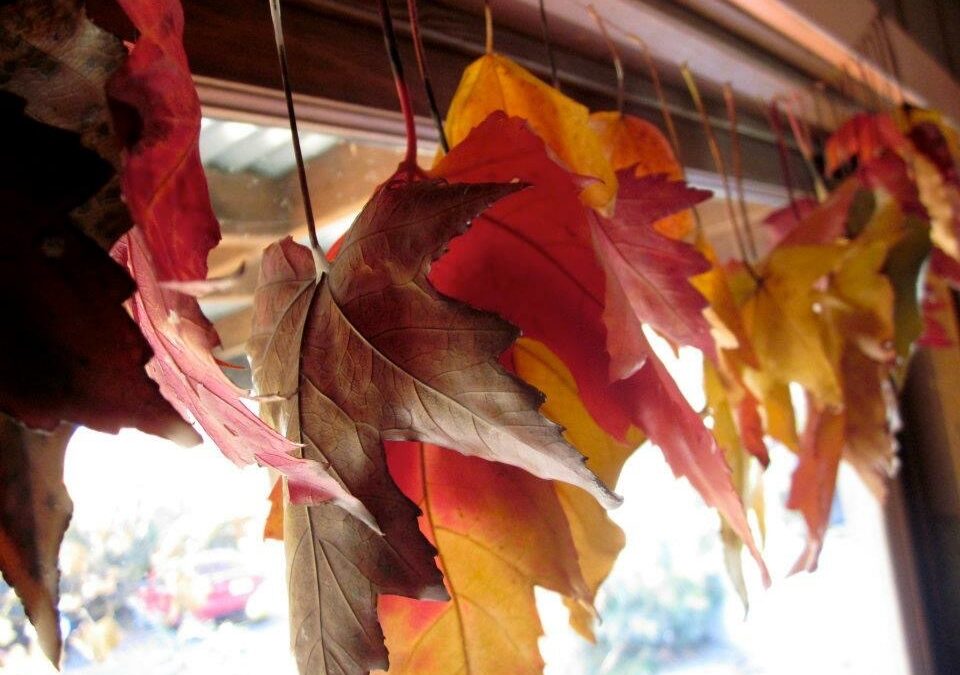
This header photo is from 16 years & 3 homes ago.
It was just me & my son then; my daughter not even a thought yet…
I was big into pinterest & I had seen a fall craft idea for dipping fall foliage in wax to preserve the colors. Unlike many pinterest craft ideas, this one truly worked & I’m pretty sure I #nailedit .
I can still recall the crunch of our feet & the smell of fallen leaves, and the feel of cool morning air on the morning Trent & I went walking to gather the leaves. The dampness of dew still clinging to them. The sight of my son’s tiny, chubby fingers, holding up leaves for me to see. The sound of his toddler voice (nonstop) narrating his experience, in the otherwise quiet morning.
Just looking at this photo brings back the smell of beeswax melting in a double-boiler on our old farm stove – the sweetness permeating our whole house & lingering.
I can still feel the warm wax on my fingers as I dipped each leaf in, and the poke of the needle through each stem once the wax had dried & I hung them as a window garland.
This is a flashback to a time in my life when my focus was fairly simple: solo parenting my toddler; making our life beautiful.
Without romanticizing the challenges of parenting small children (especially alone), I will say that this time in my life was filled with a lot of paying attention to the world through my felt senses.
There was a lot of sense pleasure in my life – from the bold colors of my son’s clothing, to making natural fibers crafts with my hands. From planting in the garden, to eating carrots straight from the garden. From snuggling his little body while reading sweet books, to joining him in watercolor play. From watergun fights, to ooh-ing & ahh-ing at the moon together.
He pulled my attention to beauty, large & small; to curious things, both beautiful & ridiculous.
My attention was being pulled, yes – but into the tangible world around me, rather than into a screen, or ‘the news’. Our pace of our life leant itself to being in touch with our senses: what we saw, what we smelled, what we heard, what we could touch with our hands – and even what things (like the miner’s lettuce we picked on our walks) tasted like.
For several years I’ve been bringing a shift in language to my teaching around the phrase ‘makes sense’ – as in ‘does that make sense?’ or ‘that makes sense’.
While the common cultural use of the term ‘make sense’ means ‘to understand through our logical mind’ – I have been coming to use it to mean ‘is resonant with what we perceive with our senses’.
There is SO MUCH that we experience that doesn’t ‘make sense’ if we only mean ‘understand through our logical mind’, but absolutely ‘makes sense’ if we mean ‘is resonant with what we perceive with our senses’!
But in order to truly feel what ‘makes sense’ -aligns with our sensory experience- we need to be far more connected to our senses than most of us are these days; to become more sensorially sensitive.
To reclaim our senses is truly to reclaim our felt sense of being alive – which is directly connected to our sense of belonging, as well as having a sense of purpose, and knowing our own power in the world. Reclaiming our senses is the foundation for everything. It is perhaps the most vital work of being human in these times.